
January 26, 2026
Micro-agents: Building Smarter AI Systems Through Focused Collaboration
Micro-agents are single-purpose agents that prevent context rot, reduce errors, and lower costs. Learn how Helpmaton helps you define, connect, and improve micro-agents over time.

Have you ever built an agent that started strong, then got slower, less accurate, and harder to steer? It happens when we pile too many responsibilities into one prompt. The result is context rot: a bloated context window where the agent is juggling too much and slipping on the details.
There is a simpler approach: micro-agents. These are single-purpose agents that do one thing well, then delegate to other specialists when needed. The result is a system that stays focused, reduces errors, and costs less to run.
In this post, I will show you what micro-agents are, why they work, and how Helpmaton makes it easy to build, monitor, and improve them.
What are micro-agents? 🎯
Micro-agents are single-purpose agents with a clear, narrow job. Think of them like a team of specialists instead of one generalist. Each agent focuses on one responsibility, and delegates to others when a task needs expertise outside its scope.
Instead of one agent that tries to do everything, you have a small team like:
- Router agent that classifies requests and assigns the right specialist
- Research agent that finds and summarizes relevant sources
- Writer agent that drafts responses in the right tone
- QA agent that checks for clarity and accuracy
Each agent stays focused, and the system coordinates their work.
The problem they solve: context rot 🧠
When a single agent handles too many tasks, the prompt grows, the context window fills, and the agent gets distracted. That is context rot. It leads to:
- Higher error rates because the agent is juggling too much context
- Longer responses because it has to sift through irrelevant details
- Higher costs because every request carries a larger prompt
Micro-agents solve this by keeping each agent focused on one job. Smaller prompts, clearer instructions, and fewer conflicts lead to better results.
How micro-agents work together 🤝
Micro-agents are powerful because they collaborate and delegate. In Helpmaton, agents can pass tasks to other agents in the same workspace, so work gets shared and tracked.
For example:
- A support agent receives a customer question.
- It delegates a technical deep dive to a specialist agent.
- The specialist returns findings.
- The support agent delivers a clear, friendly response.
Each agent stays in its lane, and the final output is better than a single agent trying to do it all.
Building micro-agents in Helpmaton 🧰
Helpmaton is designed for this style of work. Here is a simple way to set up micro-agents:
- Create a workspace for your project or team.
- Define each agent role with a narrow job and clear instructions.
- Enable agent delegation so agents can pass tasks to specialists.
- Assign tools per agent so each micro-agent has only what it needs.
Some best practices:
- One responsibility per agent: If you need two jobs, make two agents.
- Short, specific instructions: Clear roles beat long prompts.
- Use workspaces to keep projects separate and organized.
This keeps your system modular, understandable, and easy to improve.
Monitoring and improving performance over time 📈
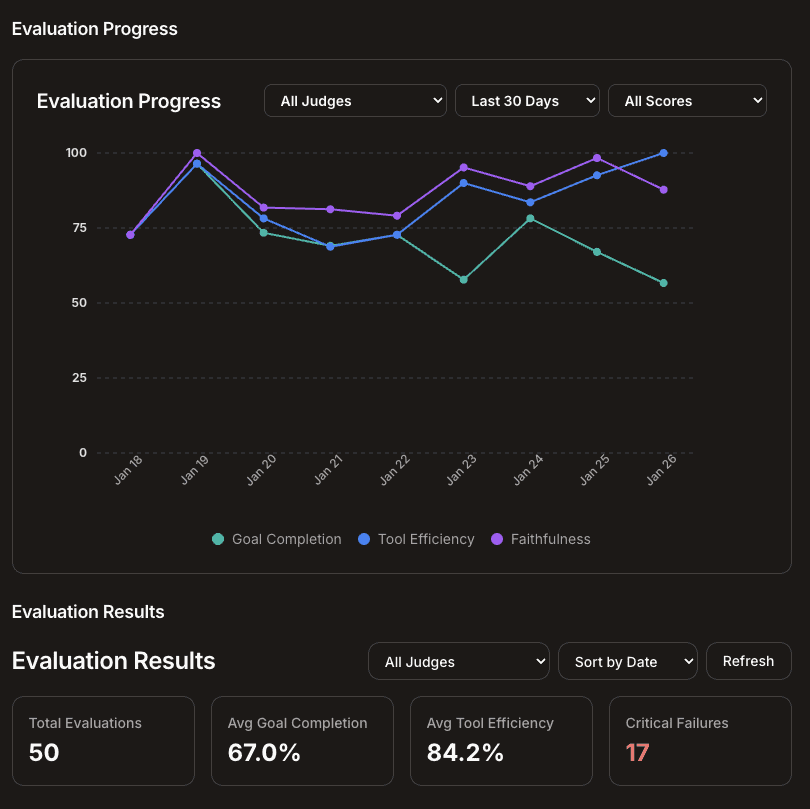
Micro-agents are not just easier to build, they are easier to improve. Helpmaton gives you tools to track performance and iterate confidently:
- Judge evals let you score conversations and catch regressions before deploying changes.
- Usage analytics show costs and activity by workspace or agent, so you can see where time and spend go.
- Error tracking surfaces failures with clear context, making issues easy to spot and fix.
With smaller, focused agents, it is easier to see what is working and what needs refinement. You can tune a single specialist without touching the rest of the system.
A real-world micro-agent workflow 🔎
Imagine a weekly product update workflow:
- A Research agent gathers product changes and release notes.
- A Summarizer agent turns those into bullet points.
- A Writer agent formats the update for email and Slack.
- A QA agent checks for missing details or unclear language.
The result is faster reporting, fewer mistakes, and a workflow that stays consistent over time. If the summary feels too long, you improve the Summarizer agent without touching the others.
Getting started
If you want to build micro-agents, start small. Define two or three focused agents, connect them with delegation, and iterate. Helpmaton makes it simple to test, monitor, and improve as you go.
Ready to get started? Create your first agent.